Ahead of the T20 World Cup match against New Zealand, Afghanistan captain Rashid Khan spoke about the importance of women’s participation in cricket and broader opportunities for all Afghans. He expressed strong support for seeing “anyone representing Afghanistan on any stage” but made clear that such decisions are made by cricket authorities, not players.
Rashid said that while players focus only on what they can control, decisions about establishing a women’s team rest with the Afghanistan Cricket Board (ACB) and the International Cricket Council (ICC).
He described seeing women represent Afghanistan internationally as a “huge proud moment”, but pointed out that administrative and policy decisions are beyond the scope of players to determine.
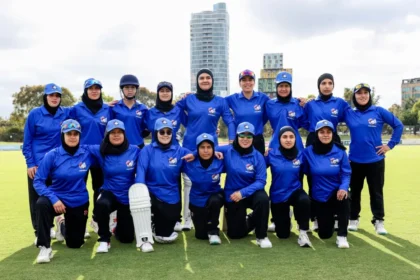
Rashid’s remarks come amid wider discussion about the absence of an official Afghanistan women’s cricket team — a situation directly tied to broader restrictions on women’s rights in the country. Since the Taliban regained control in August 2021, they have banned women and girls from participating in all sports, including cricket, stating such activities are not appropriate under their rules.
Under the Taliban’s rule, Afghanistan has seen ever‑expanding limitations on women’s rights, including bans on secondary and higher education for girls, and prohibitions on women playing sports or participating in public athletic activities. The regime has explicitly barred women from playing sports like cricket, citing ideological reasons.
These policies have severely curtailed opportunities for women across Afghan society, forcing the Afghanistan women’s cricket team into exile and leaving women without access to structured sport or education pathways.
Beyond sport, Rashid Khan — along with senior teammate Mohammad Nabi — has publicly appealed to the Taliban to reverse bans on women’s access to education, particularly in medical fields such as nursing and midwifery. He described education as a fundamental right and emphasised its importance for both men and women, noting that Afghanistan needs professionals across all sectors.
In social media posts, both players called the closure of educational opportunities for women “deeply unjust” and urged reconsideration, pointing out that restricting girls and women from education harms Afghanistan’s future.